





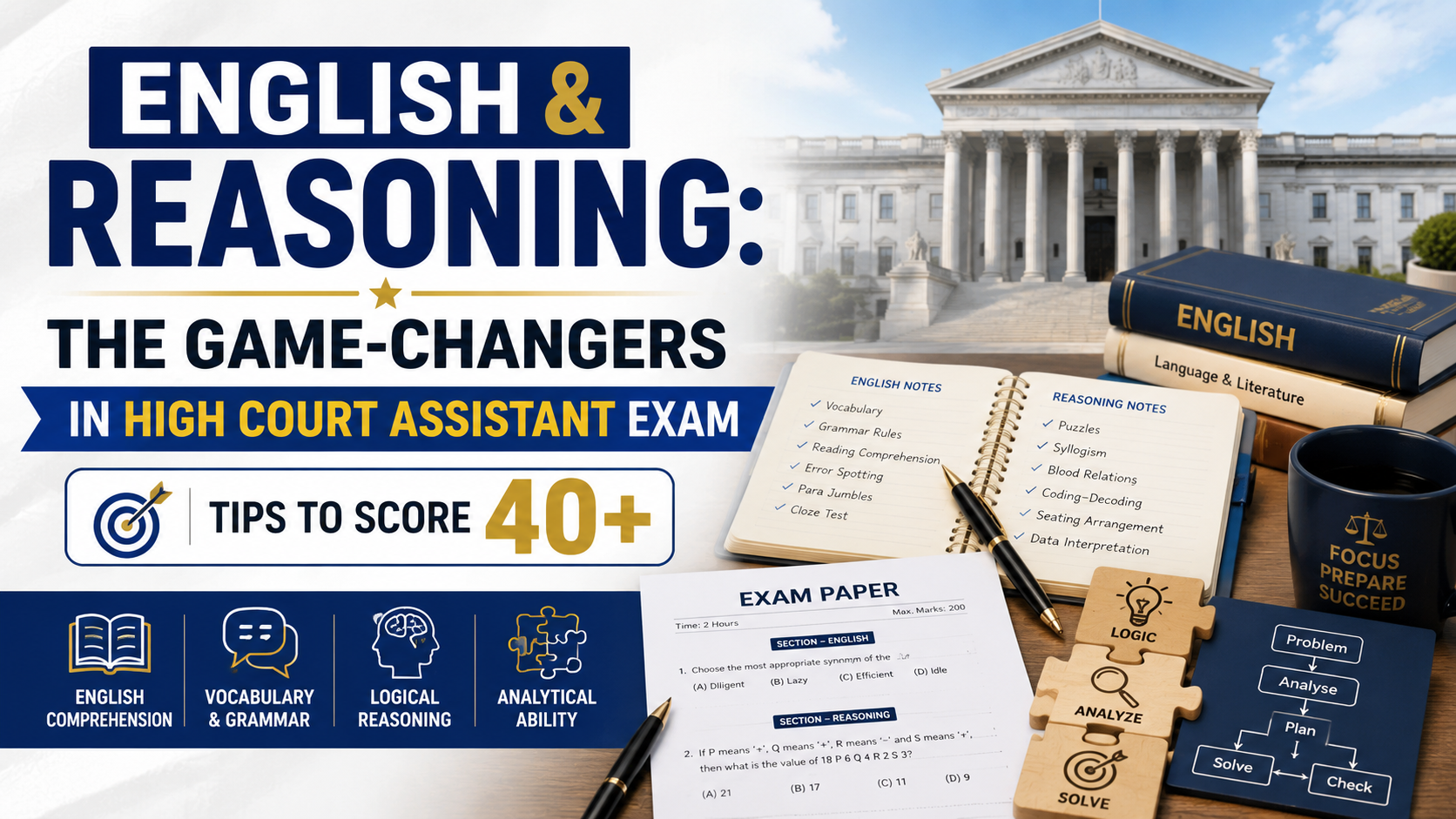
Cracking the Kerala High Court Assistant Recruitment requires a drastically different approach than your standard Kerala PSC exams. While most aspirants spend months memorizing static General Knowledge data, the real battlefield lies elsewhere.
If you want to see your name at the top of the final rank list, you must master the two most scoring segments of the objective paper: General English and Logical Reasoning.
Let’s break down exactly how these sections serve as the ultimate game-changers, along with an actionable strategy to confidently score 40+ marks out of 60 in this combined segment.
The Reality Check: Understanding the High Court Assistant Exam
PatternIn most competitive exams in Kerala, General Knowledge carries the lion’s share of marks. However, the High Court of Kerala structures its selection process to prioritize language skills and analytical sharpness.
With a 0.25 negative marking rule for every wrong answer, blind guessing in a 50-mark English paper can completely wipe out your chances. Conversely, mastering this section gives you a massive mathematical advantage over the competition.
Strategy 1: Mastering General English (Target: 35+ Out of 50)
The High Court Assistant English Syllabus doesn’t just test basic communication; it evaluates precise grammatical accuracy. Because this section makes up half of your objective score, your preparation needs to be flawless.
1. Lock Down the High-Yield Grammar Rules
Expect heavy questioning from structural grammar. Prioritize your study schedule around these core topics:
* Subject-Verb Agreement: Watch out for collective nouns, indefinite pronouns, and sentences starting with “Neither/Either”.
* Tenses and Conditionals: Memorize the structural rules for conditional clauses (e.g., If + Past Perfect, would have + V3).
* Prepositions and Phrasal Verbs: This is where most students lose marks to negative marking. Memorize fixed prepositions (e.g., abstain from, comply with).
2. Build Contextual Vocabulary Daily
Expect heavy questioning from structural grammar. Prioritize your study schedule around these core topics:
* Subject-Verb Agreement: Watch out for collective nouns, indefinite pronouns, and sentences starting with “Neither/Either”.
* Tenses and Conditionals: Memorize the structural rules for conditional clauses (e.g., If + Past Perfect, would have + V3).
* Prepositions and Phrasal Verbs: This is where most students lose marks to negative marking. Memorize fixed prepositions (e.g., abstain from, comply with).
💡 The Double-Benefit Secret: Your objective English preparation directly lays the foundation for Stage 2: The Descriptive Test (60 Marks). The grammar rules you master today will prevent structural errors when you draft your Short Essays, Précis, and Comprehensions later.
Strategy 2: Cracking Basic Math & Reasoning (Target: 8+ Out of 10)
While Basic Mathematics and Reasoning account for 10 marks combined, they represent “sure-shot” marks. If your concepts are clear, you can score 100% accuracy in this section far more easily than in General Knowledge.
1. Prioritize High-Speed Reasoning Topics
Focus on areas that rely on pure logic and quick shortcuts rather than long calculations:
* Coding-Decoding & Alphabet Series: Write down the position values of alphabets ($A=1, Z=26$) on your rough sheet the moment the exam begins to save tracking time.
* Blood Relations & Direction Sense: Use quick family-tree diagrams and standard four-cardinal-direction layouts to avoid confusion.
* Number Series & Analogy: Practice recognizing squares, cubes, and prime-number gaps instantly.
2. Time Management is Everything
You only have 75 minutes to solve 100 questions. Do not get stuck on a single math puzzle or logical arrangement. If a reasoning question takes more than 45 seconds to crack, skip it, secure your English and GK marks, and return to it later.
Step-by-Step Study Plan to Clear the Cut-off
To systematically build your score up to the 40+ threshold, structure your remaining preparation time using this 3-step formula:
1.Build Conceptual Core (Weeks 1-4)
Focus on Accuracy.
Review foundational English grammar rules (Parts of Speech, Active/Passive Voice, Direct/Indirect Speech) using standard references like S.P. Bakshi or Wren & Martin. Dedicate an hour every day to practicing single-concept reasoning shortcuts.
2.Solve Topic-Wise PYQs (Weeks 5-8)
Identify Trap Patterns.
Go through the past 5-10 years of High Court Assistant previous question papers. Isolate the English and Reasoning questions to identify repeating question patterns and common “trap” options designed to trigger negative marks.
3.Time-Bound Sectional Mocks (Weeks 9+)
Speed & Strategy Integration.
Attempt full-length mock tests under strict exam conditions (75 minutes). Analyze your performance immediately after each test. Focus on reducing negative marks in English and shortening your solving speed in Reasoning.
Final Takeaway
The path to passing the High Court Assistant Exam does not run through expansive General Knowledge books. It runs directly through your English grammar notes and your analytical problem-solving speed. If you can dominate the 60 marks controlled by English and Reasoning, you aren’t just clearing the cut-off you are securing a top spot on the final merit list.